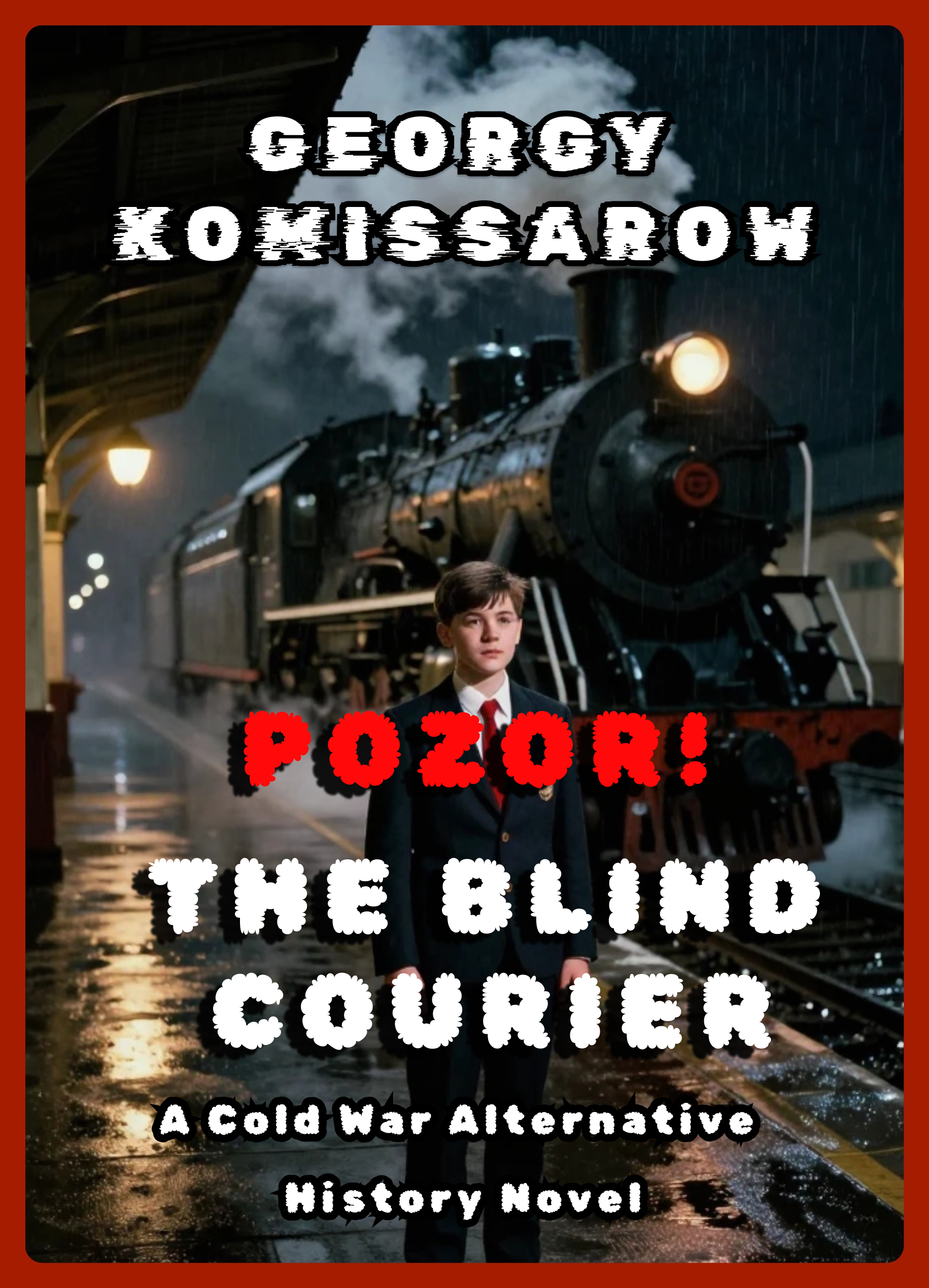
📖 BOOK SYNOPSIS
Title: POZOR! The Blind Courier
Author: Georgy Komissarow
Genre: Alternative History / Espionage Thriller / Political Detective
1984. The absolute height of the Cold War.
To the official Soviet bureaucracy, a delegation of schoolkids embarking on an official Pioneers youth exchange trip to Czechoslovakia is just a routine cultural mission. But these are no ordinary children—they are Pioneers, the Young Communists of the Soviet Union. Behind the safety of the Iron Curtain, the KGB and the CIA are already moving their pieces on a grand, dangerous, and invisible chessboard.
Meet Vit—a sharp, fiercely analytical thirteen-year-old son of a high-ranking district official. Armed with a pocketknife, an expensive mechanical camera, and a cynical understanding of Soviet black-market logistics, Vit is unexpectedly turned into a «blind courier» by state security. He is carrying a highly classified payload across international borders without his own knowledge.
From the chaotic, overcrowded platforms of the Kiev railway station to the bizarre culture shock of Western consumerism, contraband vodka hidden in teachers’ luggage, and the looming watchtowers of the border zone—this novel is a raw, deeply authentic, and masterfully written look into the final decade of a superpower.
Combining profound, firsthand knowledge of mid-1980s Soviet economics and adolescent psychology with the nail-biting suspense of a classic spy thriller, POZOR! The Blind Courier explores the ultimate question: What if the collapse of the USSR was a chess game that could have been won?
Introduction
What could a fourteen-year-old Pioneer—even a straight-A student—from an ordinary family living in a Ukrainian regional center near Kiev in 1984 possibly know about Czechoslovakia?
Practically nothing. Except, perhaps, for the basic facts from a school geography textbook: that it was a country in the socialist Bloc, bordering the Soviet Union (specifically the Ukrainian SSR), and its capital was Prague. However, being a top student—and thanks to an outstanding geography teacher—I happened to know that Czechoslovakia was a unique case among the Eastern Bloc nations: it consisted of two republics, the Czech Republic and Slovakia, and consequently had two official state languages, Czech and Slovak. I also knew that the capital of Slovakia was Bratislava.
Furthermore, as a massive buff of military history—especially the Great Patriotic War—I knew that Prague had been liberated by our tank armies on May 9th, 1945, when everyone else was already celebrating Victory Day. Our troops had saved the city from destruction and rescued the local anti-Nazi uprising. Back then, very few people actually knew that historical fact.
From spy novels and movies, one could also gather that Prague was a legendary battleground for intelligence services and secret agents from all over the world.
And that was it. Why would a Soviet kid need to know anything more?
But my case was different. After all, I didn’t grow up in an ordinary family. My father was a high-ranking regional boss—as they used to say back then, «the second most powerful man in the district.» Given that our district bordered the Kiev region and was the very first to welcome all the visiting dignitaries from the capital, you can draw your own conclusions about our status. My mother, on the other hand, was a schoolteacher—a true educator «by the grace of God.»
So, what did Czechoslovakia have to do with any of this?
During those years, it was a common state tradition for Soviet cities and districts to maintain official «friendship pacts» with sister regions across the socialist Bloc. Our twin region happened to be the city of Ostrava, along with its surrounding province.
Chapter1. My father’s stories about Czechoslovakia
All this knowledge began to appear gradually, starting around 1982, following the official trips my father took there, followed shortly by my mother. Back then, we simply referred to the locals as «the Czechs.»
From my father’s accounts of his travels, I knew that they treated us exceptionally well over there. And that was despite the attempted anti-communist coup of 1968. Which was hardly surprising—what else could you expect from a country that had become an open thoroughfare for all sorts of CIA agents and foreign spies?
During those regional exchange visits, every single Czechoslovak official who met with our delegation inevitably brought up the topic on his own accord, sharing his own personal story about those turbulent events. By and large, their stories were almost identical, sounding something like this:
*»After the shift in the Prague leadership, whispers started spreading that we were living in poverty because we were forced to feed the USSR and the entire Socialist Bloc. They said we needed to pivot our orientation toward the capitalist West. And to do that, we first had to overthrow the Communists. Well, at first, everyone just laid low, waiting for the whole thing to blow over on its own.
But then, about six months later, strange people suddenly flooded the streets one morning, demanding absolute power. They were openly calling to slaughter the Communists and anyone who supported them. Everything ground to a halt; businesses stopped working. We stayed barricaded indoors, terrified to step outside. Rumors spread like wildfire that Prague was in the middle of a bloody uprising and the Communists were finished. They said they were being slaughtered in the capital, and that the purges had already started in our town too.
We all looked forward to the arrival of the Soviet Army with desperate hope. We listened to the radio constantly, but the information was a mess—Western radio stations said one thing, while Moscow said another. And then, early one morning, we were jolted awake by loud bangs and a distant, heavy rumbling. We peeked out the windows, and those who weren’t paralyzed by fear went outside.
Down the street rolled endless columns of military hardware bearing red stars! Those loud popping sounds we’d heard turned out to be a stalled military vehicle. The local residents had rushed out to help the young Soviet soldier-driver get it running again. Right there on the street, people were already bringing him and his fellow soldiers whatever food and hot drinks they could find. We were all overjoyed, running out to embrace our liberators. The columns rolled on without stopping, the soldiers waving and smiling at us in a friendly way.
That very same day, when we finally reported to our workplaces, we found that everything was completely back to normal. Soon after, we learned that a Soviet military commander’s office had been established in the city, and Soviet troops were officially stationed in and around our town. Back then, we were absolutely ecstatic, saying this was forever. None of our colleagues were arrested, even though everyone knew exactly who the local supporters of the coup attempt were. Rumors simply went around that those people had been foolishly deceived.»*
That was how I learned the general details of those historical events. However, at my parents’ strict insistence, I kept this classified information strictly to myself and didn’t spread it anywhere.
All the other news and stories Dad brought back, however, were of a completely different nature.
For instance, my father mentioned that during meetings that were informal—or, to use our heavy administrative slang of the time, «p’yankas» (drinking parties)—the Czechs actually drank and ate remarkably little compared to us. Instead, they were incredibly fond of roasting thick or thin sausages over an open campfire. That was the very first time I ever heard the word «shpikachki». The cooking process was dead simple: they just skewered them on long wooden sticks, and everyone gathered around the fire to roast them, washing it all down with a modest amount of dry wine or Czech beer.
But despite their modest appetite, they were incredibly lively people. They would transition to dancing almost instantly. Furthermore, their events always featured a massive female presence. In our regional circles, you’d lucky to see one or two women at such gatherings, and things practically never progressed to dancing.
When my father recounted this to his friends in my presence, he always added that the Czech women were exceptionally beautiful and cultured. Much later, I came to the mature conclusion that they were probably just well-groomed and elegantly dressed, which naturally made a massive impression on our provincial men. At this exact point in the story, Dad would always shoot me a highly expressive, loaded glare, which translated to: Not a single word to your mother.
At these gatherings, according to Dad, it was completely in the order of things—without waiting for any traditional «White Dances»—for a woman to confidently march up and invite any man to dance. To make things even more unusual, married couples often attended together but would happily dance with completely different partners all night.
It was also entirely within their local spirit and customs to casually kiss each other right on the lips in front of everyone for any random reason. Sure, we have a similar kissing tradition back home, but it usually manifests at a very raw, informal, grassroots level—and only when it’s strictly among «svoi» (our own people), like at large family gatherings. Or, conversely, at the ultra-high state level—official diplomatic meetings, award ceremonies, and so on. Everyone in the world was well aware of our top leadership’s notorious passion for fraternal kissing back then! But in Czechoslovakia, nobody felt a shred of shyness about this, even at a completely mundane, everyday level with total strangers.
Detailing these trips to his friends, Dad would note with a chuckle that while he highly approved of this Czech tradition of kissing beautiful women, having to kiss men—even if it was his own administrative superiors—utterly disgusted him. And as usual, he would stare at me intently, making sure his wife wouldn’t find out.
His friends instantly caught on to his nervous glances and began to relentlessly mock him, joking that his wife had «vzyala yego pod nozh»—meaning she ‘had him under the knife’, keeping him on a tight leash—and had slapped him with a strict 11 PM curfew.
For our isolated district center and our people back in 1984, such European liberties were simply too much to handle. Naturally, it triggered a wave of smirks and roaring laughter from his buddies. Except, of course, for my mother. At this specific juncture of the story—the part about the wild dancing and open kissing—she would visibly tense up. Dad tried to lighten the mood, or so he fondly thought, by hastily adding that he personally hadn’t danced with a single soul, let alone kissed anyone.
But his defense didn’t hold up for long. One of Mom’s close friends—the wife of another local boss—later secretly filled her in on the real story. She revealed that the delegation had received strict instructions from the top regional leadership not to show any public indignation, not to turn up their noses, and to do exactly as the Czechs did!
She dynamically added that the local women practically wouldn’t leave my father alone, and that a certain Czech lady was even furiously jealous of his Soviet wife. Hearing this, their local supervisor immediately reprimanded the over-enthusiastic lady and packed her off home.
Well, I won’t fully describe the massive storm that unfolded at our house afterward. I can only say that I heard the entire domestic battlefield raging from behind the closed doors of my bedroom. My mother was completely «na role»—meaning she was in peak, unstoppable form, delivering a furious, epic lecture.
It looks incredibly funny to me now, but back then, it certainly wasn’t a laughing matter.
Chapter 2. My Mother’s trip
I can’t recall exactly where or at what point during the trip Mom finally realized that both sexes shared the exact same steam room. All I know is that she delicately but firmly refused to participate, forcing the rest of our regional representatives to back out along with her.
The funniest part, however, was a realization that hit Mom much later, once she was already back home: if they were the very first to refuse, it meant that all the previous Soviet delegations before them had happily agreed to it without a single complaint! Or perhaps she simply cross-examined those who had traveled before her.
In short, the whole thing turned into a hilarious domestic curiosity. Especially after my dad hastily replied that he personally detested saunas, had never set foot in one, and this was the absolute first time he was ever hearing about such mixed-gender steaming. Back then, Dad’s innocent, defensive prank looked quite convincing to me, but now it just makes me laugh at our sheer naivety.
Of course, that was still the early 1980s. It was only during the late-80s Perestroika era that the public would finally discover that steaming together in saunas was not only normal but actually the ultimate, absolute favorite pastime of the top leadership of the Communist Party and the Komsomol. Our famous, scandalous movie ChP: Regional Emergency (1988) perfectly illustrated that exact reality later on.
Chapter 3. Dad’s Czechoslovak shopping trip
Well, another critical point—probably the main priority for any Soviet citizen visiting a foreign country back then—was, first and foremost, the acquisition of Western clothes. I will touch upon this subject many times, as shopping was the absolute most beloved aspect of any trip abroad, driven by the total, agonizing lack of normal consumer goods in our own country at the time.
And so, my dad—in his dual capacity as the head of our official delegation and the «second most powerful man» of our friendly district—was escorted straight to the central department store in Ostrava [shopping].
Architecturally, it was a typical commercial building for Czechoslovakia: a multi-story general store spanning three floors of glass and concrete, outfitted with modern elevators and escalators. Everything operated on a self-service basis. The ground floor housed groceries and basic consumer goods; the second floor was packed with appliances and household electronics; while the third floor was dedicated entirely to clothes and shoes.
Back in our own district center, we also boasted a local supermarket and a state department store. But trying to compare them to this Czechoslovakian shopping center was like comparing a premium western mall to a crude «lobáz»—our word for a primitive, muddy storage shed—at our local collective-farm market. Back home, selling sunflower oil on tap directly from a giant wooden barrel was still considered completely in the order of things. Well, I eventually saw it all with my own eyes and made the comparison myself.
Having visited Kiev many times before, I could compare the Ostrava center to the high-end department store on Lvovskaya Square, or to the exclusive Leipzig shopping center in Moscow.
But let’s get back to Dad. He had been thoroughly briefed about this upcoming shopping event back in the Soviet Union—or «The Union,» as it was customary to call the USSR whenever you traveled abroad, regardless of which specific Soviet republic you hailed from.
Back home, our regional bosses had handed him rather vague, contradictory instructions on the matter: «Do not dare offend the hosts by refusing their hospitality! But at the same time, never forget about the pride and dignity of a Soviet citizen, a Communist, and remember that you are standing on the ideological front line!» and so on.
And so, they march into the department store, and Dad notices that the place is completely deserted. The store is officially closed to the public, yet our delegation is allowed inside. His local Czech guide smiles and tells him that he has about two hours at his disposal—and even longer if he runs out of time. He can simply relax, browse the aisles, pick out absolutely whatever he wants, and take it entirely for free—completely on the house, as a total giveaway. Literally anything available in this giant department store was his for the taking! Now that’s a real ideological twist: how to avoid offending your hosts without dropping your communist honor?
Before the trip, of course, Dad had tried to chat with colleagues who had already visited Ostrava, but everyone had nervously avoided this slippery, delicate topic. Only one person—his direct supervisor from the regional committee—had handed him specific, highly practical recommendations.
Namely, he noted that as a high-ranking official who required a daily business style in clothing, hosted formal meetings with foreigners, and frequently traveled on state business trips, Dad could safely afford to walk away with the following:
Four premium weekend suits (two summer and two demi-season).
Two high-quality raincoats.
Four dress shirts.
Four pairs of quality leather shoes.
Two athletic tracksuits.
Several sets of socks and underwear.
Any premium haberdashery and leather-care products.
High-end perfumery and cosmetics.
For the spouse and children back home, he was allowed to take the exact same set, but strictly in one copy each. And, of course, a matching tribute for his immediate bosses in the region.
There was also a separate allowance for souvenirs and the famous local brand «Bohemian Glass»—or, as we simply called it, crystal. But he was told to do it without fanaticism: no more than 10 complete sets.
So, being properly warned, Dad had prepared a strict shopping list in advance, complete with exact sizes and desired colors. Within minutes, the store staff very quickly gathered his selections, packed them into boxes, and delivered them straight to his hotel room.
For that era, it was a literal, kingly treasure. The suits turned out to be Finnish, the shoes were West German, and the raincoats and shirts were Czech-made but of absolutely immaculate quality. Even by today’s standards, such a haul would not be cheap.
Mind you, if you can imagine the sheer wealth of any modern small-town official today, they could buy out that entire department store if they wanted to. But my dad, despite being a powerful regional boss, was absolutely honest. Today, they simply don’t make people like that anymore.
Chapter 4. The Czechs are here
Later on, I learned from my father about the official return visit of the Czechoslovak delegation to our district. It was their very first time coming to our backyard, and naturally, our entire regional leadership was absolutely sweating with anxiety. Why were they so terrified? I only fully understood later, after I visited Czechoslovakia myself.
In the meantime, the rumors back home claimed that the Czechs were incredibly light drinkers, barely ate anything, and were eerily, terrifyingly cultured. They allegedly didn’t blow their noses into the curtains, tablecloths, or their bare fists, and they certainly didn’t wipe their greasy hands on them. So how on earth were we supposed to entertain them?
Once again, Dad was rescued by his regional chief, who casually told him: «Just host them exactly the way we host Comrade Shcherbitsky—the First Secretary of Ukraine. But since it’s summer, skip the formal hunting trips. Do fishing, a river cruise, fresh fish soup cooked over a campfire, a proper barbecue, and a boat ride. Fire up the bathhouse at one of our elite boarding houses on the Desna River and lodge them over there.»
And that’s exactly what our administration did, even though everyone was shaking with fear.
And lo and behold—a miracle occurred! It turned out that the second a bottle of genuine Soviet vodka hit the table, our Czechoslovak comrades happily ditched their light wines and began chugging the hard liquor with immense pleasure! They kept up with their Soviet hosts drink for drink, matching them shot for shot—though, admittedly, not without severe biological consequences. We are talking classic, catastrophic face-plants straight into the salad bowls and passing out dead cold under the tables. Not to mention—ahem—the total, involuntary relaxation of both the bladder and the bowels. My deepest apologies for such graphic, unvarnished details!
Another completely unexpected revelation for our administration was the Czechs’ sheer, boundless amorousness—perfectly paired with the absolute, enthusiastic availability of our local women. It was a literal lifesaver that the entire wild party took place outdoors by the water, or at worst, secluded inside the resort complex. At least all the debauchery wasn’t out in the open, so to speak.
After the delegation left, several of our local female officials had to quickly invent creative, airtight alibis to explain their sudden two-week absence from the domestic hearth. Back then, skipping a night or two at home wasn’t even viewed as a misdemeanor by their husbands: «Hey, it’s the peak of the harvest season, and she’s a senior district official, after all! She’s sleeping at the office!»
Well, time flew by. When the return visit ended, boarding the Czechs onto the train back at the Kiev railway station turned out to be a pretty mundane, industrial affair. Our Czechoslovak comrades were simply carried inside the carriages by our strongest men and laid out like logs onto their respective bunks. All in all, everything went splendidly.
Chapter 13. TASK
Farewell and parting words
Our KGB handler subtly gestured to me. As it turned out, I was one of the very first to step out of the carriage for the official farewell ceremony, and—as if entirely by chance—I found myself standing right next to him.
Flashing a friendly, completely benign smile, he warmly wished me all the best on my journey and a safe return to my native land. At the exact same time, without changing his good-natured facial expression by a single fraction, he quietly informed me that there was now a hidden bundle tucked away inside my luggage. He added that a contact person would eventually approach me abroad and introduce himself.
«How exactly would you like him to introduce himself, so you won’t forget the password?» the handler asked smoothly.
«Let him say he’s from Uncle Sigismund,» I replied on the fly.
The KGB man gave an understanding nod, making it clear that he was fully «v kurse»—in the loop—about the actual name of my real-world uncle living in Zhmerinka.
«The package is quite small,» the handler continued in a low, conversational murmur. «There is a large-format camera lens inside. Under no circumstances should you open it or look inside. The item is extremely fragile, highly expensive, and sealed in special protective wrapping for safety. Naturally, you must not utter a single word about this to anyone. You don’t need to take any extraordinary security measures to keep it safe either—just treat it with the same casual care as your regular belongings.»
This was his subtle, loaded hint, letting me know that he was well aware that I was also carrying quite a few expensive «gifts» abroad myself, including elite optics, which were highly valued on the black market outside the USSR.
Right then, I felt a literal electric shock run down my spine. A terrifying question flashed in my brain: how on earth did this package get inside my bag? After all, my luggage was locked tight with my secret pride and joy—a heavy padlock with a custom numerical cipher!
The handler answered my silent, panicked question with a simple, reassuring nod of his eyes, silently communicating that everything was perfectly under control. Before that exact millisecond, I had no earthly idea that a human being could actually «nod with their eyes.» I’ll definitely need to practice that trick in front of a mirror later, I thought.
Personally, I could already move my ears—both together and completely separately—much to the absolute admiration and fierce envy of not only my peers but grown-ups too. Back in the day, my older brother used to make bets on beer with his buddies using my ears as a weapon, and he won every single time. Nobody believed it was anatomically possible until they saw the obvious evidence with their own eyes, losing their money on the spot. Of course, many of his buddies argued that real ear-moving should look massive, like a German Shepherd or a wild safari elephant. To which my brother would confidently shoot back: «Wait, are their ears moving? Yes, they’re moving! Can you do that? No! So cough up the cash, you lost!»
And now, I was going to learn how to nod with my eyes too! «Vo klass!»—way cool! All of these chaotic thoughts flashed through my teenage mind in a fraction of a second.
Wrapping up his brief, the KGB handler added the emergency protocols: «If nobody shows up abroad to collect the lens, you will have to deposit the package into a luggage locker on your way back through the Prague railway station. Write down the locker number, and enter your birthday as the security code. The machine requires five digits, but it’s not a big deal if you just pad the last slot with a ‘1’. If there are no automated lockers available, simply hand the package over to a standard manned cloakroom. You know how those work, right?»
«Of course,» I nodded.
«Good. Over there, they won’t ask for your last name; they’ll just hand you a paper receipt, and you give them the bag. You’ll pay the fee upon retrieval based on the actual number of storage days. You will need to keep that receipt safe and bring it back home. I will personally come by your house to collect it later.»
It honestly takes so much longer to write and read all of this than it took us to discuss it. Our entire high-stakes operational briefing was wrapped up in under sixty seconds.
By now, everyone had finally stepped out of the train. We moved over to the far side of the platform, switching to an adjacent track. This area was completely empty—no incoming trains were scheduled—making it significantly less crowded. The teachers held another rapid roll call, and then the group began saying their final goodbyes to the send-off party.
Our handler from the Kiev regional committee delivered the same final speech to the entire squad. He asserted that our absolute primary objective was to forge deep friendships with our Czechoslovak peers and demonstrate to them that we were exactly the same as them.
«Just be yourselves, and don’t be terrified of embarrassing yourselves or letting anyone down,» he urged us. «Everything should feel natural. The Czechs are not afraid of anything, and they have absolutely nothing to lose. So, leave your modesty back home!»
To be completely honest, that final remark majorly surprised me. But later, of course, I fully understood his logic. We Soviets are incredibly constrained by our rigid institutional limits. The second we find ourselves thrust into an unfamiliar foreign environment, we become even more isolated and defensive—and because of that insular behavior, we often end up looking hostile, paranoid, and frightening to the outside world. We simply smile way too little compared to foreign citizens.
End of Free Preview
Total book volume: 110 pages
🏆 The Literary Phenomenon from Russia — Now in English!
⭐⭐⭐⭐⭐ «A brilliant deconstruction of Cold War clichés»
“As a fan of classic espionage, I was blown away by the depth of this book. Unlike Hollywood spy thrillers, Komissarov provides a raw, masterfully detailed, and authentic look into the internal logistics and psychology of the 1980s Soviet Union. The historical accuracy regarding economics and the bureaucracy of the era is simply flawless. A must-read for anyone obsessed with alternative history.”
— Historical Fiction Review Portal⭐⭐⭐⭐⭐ «Tom Clancy meets John le Carré, but with a unique Soviet twist»
“The dynamic between the teenage characters is incredibly vivid and funny, while the underlying suspense of the KGB operation keeps you on edge. The train journey toward Czechoslovakia feels claustrophobic and intense. I haven’t read anything this gripping in a long time. It makes you genuinely wonder: what if the USSR actually won that final chess game?”
— LitRes Bestseller Community (Translated from Russian)⭐⭐⭐⭐⭐ «Astounding historical realism and great humor»
“What I loved most is the sharp, nostalgic humor and the vivid depiction of provincial Soviet life before the collapse. The contrast between the rigid party discipline and the domestic comedic drama inside the protagonist’s family is pure gold. It’s intelligent, fast-paced, and highly educational.”
— Reader’s Choice Awards Group
💳 HOW TO BUY (Step-by-Step Guide)
Payment for the book is securely processed through Lava.top, a reliable international digital content and donation platform. Since this is handled via a direct donation link, please follow these simple steps to secure your copy:
- Click the Button Below: You will be securely redirected to our official page on Lava.top.
- Enter the Amount: 5$.
- Complete the Payment: Choose your preferred global payment method and complete the secure transaction.
- Send Us a Notice: Immediately after your purchase, fill out the short form below (or email your transaction receipt to yu55.yu55@yandex.ru), providing the email address where you would like the full book bundle sent. Your files (EPUB, MOBI, and PDF inside a single ZIP archive) will be dispatched directly to your inbox instantly!
Price: 5$ | Direct Safe Link.
📩 Secure Checkout Notice
Please use the form below or send a quick email to submit your payment details so we can deliver your digital novel immediately.
📢 PLEASE NOTE (Delivery Schedule):
Our secure payment system on Lava.top accepts orders 24/7, worldwide.
However, please bear in mind that book files are delivered manually by the author.
Digital delivery is executed daily between 9:00 AM and 10:00 PM Central European Time (CET).
If you make a purchase during the night, your e-book bundle will be dispatched straight to your inbox early the following morning. Thank you for your patience and for supporting independent authors!
⚠️ LEGAL DISCLAIMER
Please read the following notice before purchasing or reading this book:
- Fiction and Alternative History: This book is entirely a work of fiction. Names, characters, places, and events are products of the author’s imagination or used fictitiously; any resemblance to real persons or events is coincidental.
- Historical Context and Entities: Mentions of historical agencies and organizations like the KGB, CIA, or Pioneers (Young Communists) are used strictly for artistic storytelling and historical framing within the alternative history genre and do not reflect real-world endorsements.
- Depiction of Minor Characters: The inclusion of minor characters involves purely fictional situations within a coming-of-age and espionage narrative, containing no inappropriate content.
- Copyright Notice: All rights reserved. Unauthorized reproduction, distribution, or transmission of any part of this publication is prohibited without prior written permission.